

Breaking the Immersion
How this World Cup's crowning moment is a perfect metaphor for a flawed tournament.

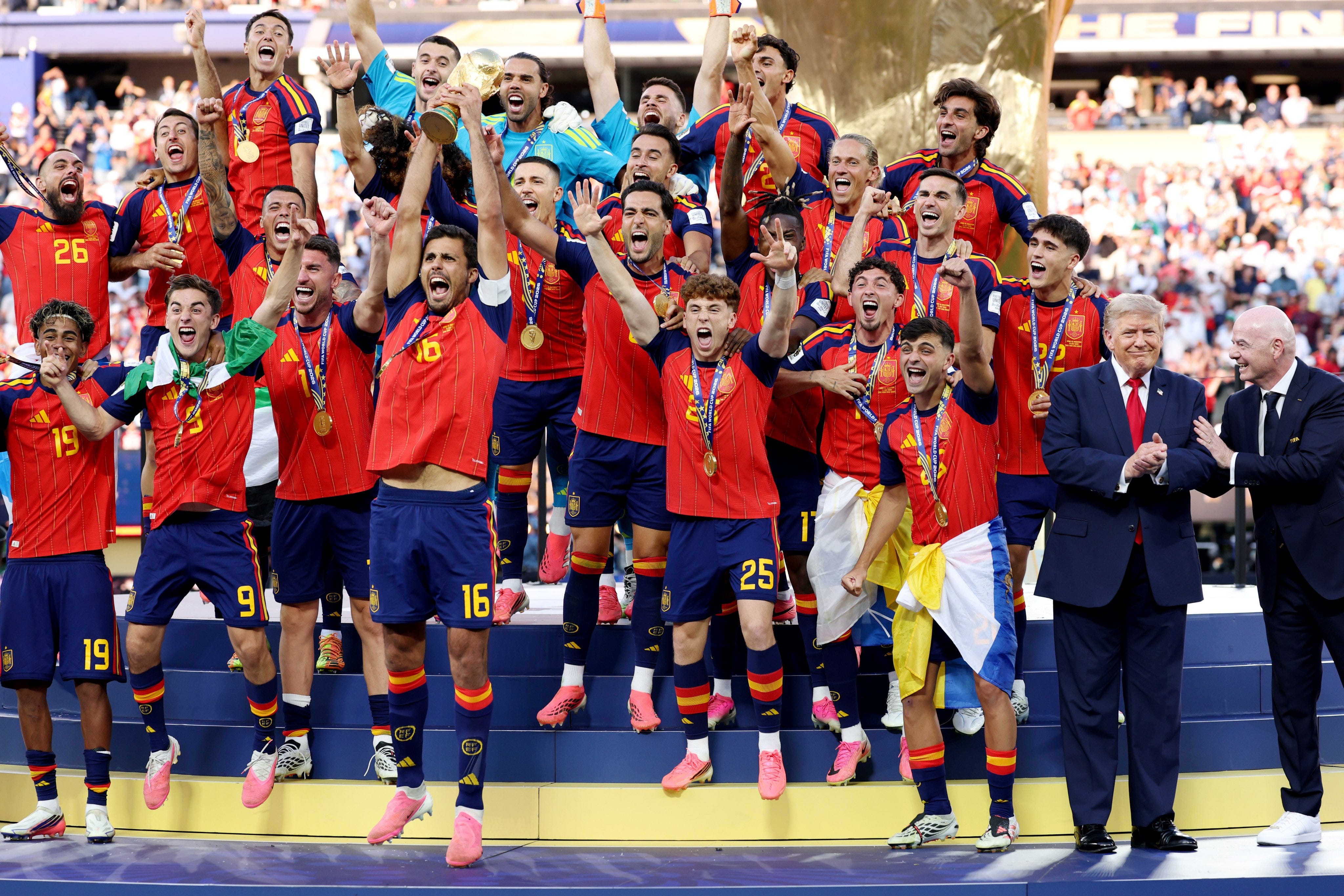
Every World Cup eventually produces an image that encapsulates the entire tournament, one moment into which a month of football seems miraculously compressed. This tournament saved its defining image until the very end.
It was supposed to be a magical scene. The irrepressible Spanish had so thoroughly outclassed their graceless, thuggish Argentinian counterparts that Ferran Torres’s winner felt like karmic justice. Now the new rightful kings of football stepped forward to receive their crown and pass into sporting immortality.
But as the inspirational Rodri thrust football’s greatest idol into the New Jersey sky, the eye was drawn by a stomach-churning distraction. There, loitering at the edge of the shot, grinning vacantly amid the chaos and confetti, stood Donald Trump.
In a depressingly predictable act of narcissism, Trump had fulfilled his obligation to present the trophy but refused to disappear. There he stood, photobombing history. A gurning, bloated monument to his own conviction that no human achievement is complete without his presence.
And so, as the World Cup produced its enduring image, Trump had – inevitably - made it about himself. You could try to look beyond him, towards the joy, the beauty, the heroism. But you could not stop seeing him.
Hours after the event my anger at Trump’s shenanigans has calmed into quiet bemusement. But I have also arrived at the opinion that this moment is a perfect and fitting microcosm of the World Cup more broadly. For here is the tournament’s central tension captured in a single image: a beautiful thing ruined by something sinister obstructing our view of it.
The World Cup has always been an act of collective make-believe. For one month, ordinary life recedes and the tournament supplies its own reality, complete with heroes, villains and images that will outlive us all. A goal becomes a national memory, a missed penalty an ancestral trauma. We do not merely watch the World Cup unfold but surrender to its narratives. We layer memory after memory onto the great shared story of what came before. That is its gift. It permits us to immerse ourselves in a magical realm of myth and heritage.
Make no mistake, this summer has provided plenty of material to sustain the fantasy. The world’s biggest superstars produced performances fit for the game’s largest stage: Messi raging against the dying of the light, Haaland mauling terrified defenders, Bellingham bending matches around his own hero complex. There were crazy, high-scoring skirmishes - including several that belong in any argument about the greatest World Cup games ever played. There was Vozinha leading Cape Verde’s improbable adventure, Paraguay toppling Germany. Scotland turning Boston into a delirious outpost of Glasgow and an American supporter culture finally beginning to look lived-in rather than manufactured.
But just as one began to truly relax into the World Cup magic, the immersion was broken by the ugly realities underpinning this tournament.
Sometimes the spell was broken by FIFA tangibly reshaping the game. Mandatory hydration pauses chopped halves into quarters, destroying the rhythm just as matches began to acquire momentum. Every stoppage became another reminder of the game’s increasing and crushing corporatism, where even the game’s natural flow could be carved up and sold.
There was the ubiquitous presence of Aramco. Around the pitch, embedded in match graphics and tattooed on the visual language of the entire tournament. At an event already carrying a hideous environmental cost – where teams and supporters unnecessarily zig-zagged across an entire continent - the omnipresence of a Saudi oil giant was truly jarring. As we all sweated through a hellish heatwave in Britain, every colourful advert dragged the horrific, dystopian spectre of the climate crisis back into view.
Again and again, the football was treated as insufficient. A match could not simply be presented as a spectacle on its own merits. Instead, we needed celebrities reacting to it. Rather than linger on the supporters who had crossed oceans and emptied savings accounts to be there, the cameras compulsively hunted the executive boxes for famous faces. Football’s traditional congregation became mere background noise to a slew of disinterested actors, influencers and corporate guests - a melancholy reminder of the game’s slow eviction of the people who made it matter.
This trend reached its nadir with the appalling World Cup final half-time show. In a tournament that had repeatedly adopted the worst excesses of American sporting culture, this was the most grotesque import of all: a bloated slab of celebrity pageantry inserted into the middle of football’s most important match. Half-time was extended, the players were made to wait and FIFA broke its own rules to accommodate a baffling multisensory assault. It is a thoroughly depressing indictment of FIFA’s vision for football that the world’s most important sporting event was forced to accommodate the so-called entertainment rather than the other way around. Even the World Cup final, apparently, is no longer enough.
And then, with the regularity of a station ident, came Gianni Infantino’s smug face, football’s self-appointed overlord. Apparently determined that no match should pass without forcing us to clap eyes on his blindingly shiny head, Infantino installed himself in executive box after executive box, surveying the tournament from each new lair with an admittedly impressive posture for a man so conspicuously lacking a spine. Every cut to FIFA’s preening gatekeeper carried the same dispiriting reminder: someone truly dreadful owns our footballing happiness, and he appears truly delighted by its resale value.
But if these in-stadium intrusions provided painful reminders of the distortion of our beautiful sport, the wider news cycle attached to the tournament became a relentless churn of depressing, dystopian reality, beside which even the tournament’s highest sporting stakes seemed trivial.
Players and officials were questioned or denied entry. Iran’s delegation was subjected to what its federation called discriminatory treatment. Omar Artan, who would have become the first Somali referee at a World Cup, was turned away, interrogated for hours and publicly smeared with insinuations about terrorism.
And then there was the disgusting Florian Balogun soap opera, which saw the tournament subject to blatant political interference by the Mango Mussolini, as Trump personally pressured Infantino to reverse the striker’s red card before a match against Belgium. Of course the fawning Infantino obliged.
These stories tore away whatever illusion remained. This was not simply a World Cup taking place in America. It was a World Cup staged against the hideous backdrop of MAGA America, in all its performatively hostile, openly corrupt glory. It will surprise no one that FIFA and Infantino were not only its reluctant guests but its eager, sycophantic accomplices.
On reflection, for most supporters, none of these intrusions destroyed the tournament individually. That was almost the problem. Though each left a sour taste, they were just about tolerable in isolation: one more advert, one more VIP, one more sickening news story. The spell did not break in a single dramatic rupture. It died by a thousand cuts, each small enough to ignore until the accumulated wound became impossible to deny. Only in combination did these smaller moments make true immersion - pure, unmitigated enjoyment of this magical tradition - intellectually impossible.
And I did my best to enjoy it! This was my first World Cup in person. And as I wrote in my previous blog, being in America was frequently joyous. At its best, it was vivid, communal, exhilarating, life-affirming and everything I had wanted a World Cup to be.
But the enjoyment resembled a fitful night’s sleep, each beautiful dream sequence interrupted by another unwanted awakening. Every intrusion dragged me out of the dream. Throughout the tournament, Gianni Infantino – football’s very own fraudulent Wizard of Oz – boomed and begged at to pay no attention to what lay behind the curtain. In many ways I was desperate not to.
But this tournament made looking away impossible. And what the curtain concealed was a slew of sponsors, executives and politicians vampirically sucking the life from the greatest sporting event in the world in pursuit of every available dollar and modicum of political capital. Each glimpse was a reminder that this World Cup was built not on sand, but on corruption, exploitation, intolerance and - yes - blood.
Perhaps this is simply what the World Cup is now. Perhaps the purity I miss never existed. Previous tournaments were hardly innocent. They were sold, manipulated and politically compromised too. Let us not forget that the World Cup has been used to cleanse and prop up bloodier regimes than that belonging to the current occupant of the White House.
But in an increasingly shameless world, this tournament was especially brazen about its shortcomings. It looked us squarely in the eye, made no attempt to conceal the ugliness, and insisted that we surrender to the magic anyway.
For six weeks, the football kept offering us transcendent moments of beauty. But everything surrounding it kept barging into the frame. So how fitting that, in the end, the tournament produced one final image in which the magic and its desecration stood side by side.
And so we return to the stage, where this confounding World Cup presented itself in miniature. A collective of Spanish wizards bouncing together. A glorious golden symbol of greatness floating above their heads. Fireworks, confetti and shrieks of joy filling the air. A moment of pure, epic mythology.
Except, desecrating this perfect scene like a grease stain on a Caravaggio, there he stands. Trump. All that beauty. All that purity. All that heritage. And at the edge of the frame, a grinning orange monument to everything rancid beyond it.
The crushing presence of reality, refusing to fuck off. We deserve so much better.
A brilliant but depressing indictment not only of the 2026 World Cup, but of football in general.
'surveying the tournament from each new lair with an admittedly impressive posture for a man so conspicuously lacking a spine.' that made me laugh out loud 😆 excellently written, and a great indictment