

Conquering the Palace: Macclesfield’s Perfect Giantkilling
Josh breaks down the meaning of the greatest FA Cup shock of all time


Sometimes moments are simply too big to let pass without comment.
Today I’ve watched an FA Cup giant killing of such bone-warming perfection that I’ve come up for air from my PhD write-up to wax lyrical about that most cliched of footballing topics: the magic of the cup.
Unless you’ve been living under a rock you’ll know that the brilliant Macclesfield Town beat FA Cup holders Crystal Palace at Moss Rose today. As I sit writing just minutes on from the final whistle, the Silkmen’s 2-1 victory is already being regarded the greatest FA Cup upset of all time. It’s hard to disagree.
To put the magnitude of today’s result into perspective, let’s run down a quick tale of the tape.
The distance between the two sides at kick off could not have been bigger. Palace started today 13th place in the Premier League, a full 117 league table positions above Macclesfield of the semi-professional sixth tier. There has never been a greater gap between sides overturned in an FA Cup tie.
It’s also the first time a non-league side has knocked out the holders of the competition since 1909. It’s one of those rare occasions where the usual biblical metaphors don’t quite do the mismatch justice. Palace are a team of international superstars. They fielded two full England internationals in their starting XI. Macclesfield are a team of part-timers who’s players hold down second jobs to pay the bills.
If this was indeed David vs Goliath, then David had one hand tied behind his back and Goliath had a shotgun. And yet somehow David prevailed.
For Macclesfield, the importance of today’s game cannot be overstated. They are a club who have been to hell and back over the past decade.
Having spent the majority of their history as perennial strugglers in the lower reaches of the football league, the original Macclesfield Town F.C. were wound up by a High Court ruling in 2020 after years of financial turmoil. 146 years of footballing history were consigned to the scrapheap, leaving a struggling post-industrial Cheshire town without its beating heart.
Despite 3 promotions in 4 seasons since their reformation in 2021 life for Macclesfield supporters has continued to be defined by struggle and tragedy. This reached a particular nadir with the recent death of striker Ethan McLeod, who died in a car accident while travelling back from their National League North match at Bedford a little over a month ago
It’s this backdrop of struggle, grief and upheaval which makes Macclesfield’s achievement particularly remarkable. It is an encapsulation of the unique emotionality, resilience and grit that defines non-league football. Perhaps more than any other fanbase in the country, the Silkmen have experienced the very worst things one can as a community of supporters. They’ve spent years shrouded in existential dread, seen their club fold and mourned the death of one of their own.
Not long ago, Macclesfield’s supporters would have (rightly) feared that they would never get to see their beloved Silkmen grace the Moss Rose pitch again. Today, in the biting cold January cold, they have experienced that rickety old sanctuary’s greatest ever moment. All of that tragedy and upheaval will underscore and amplify tonight’s moment of unbridled catharsis.
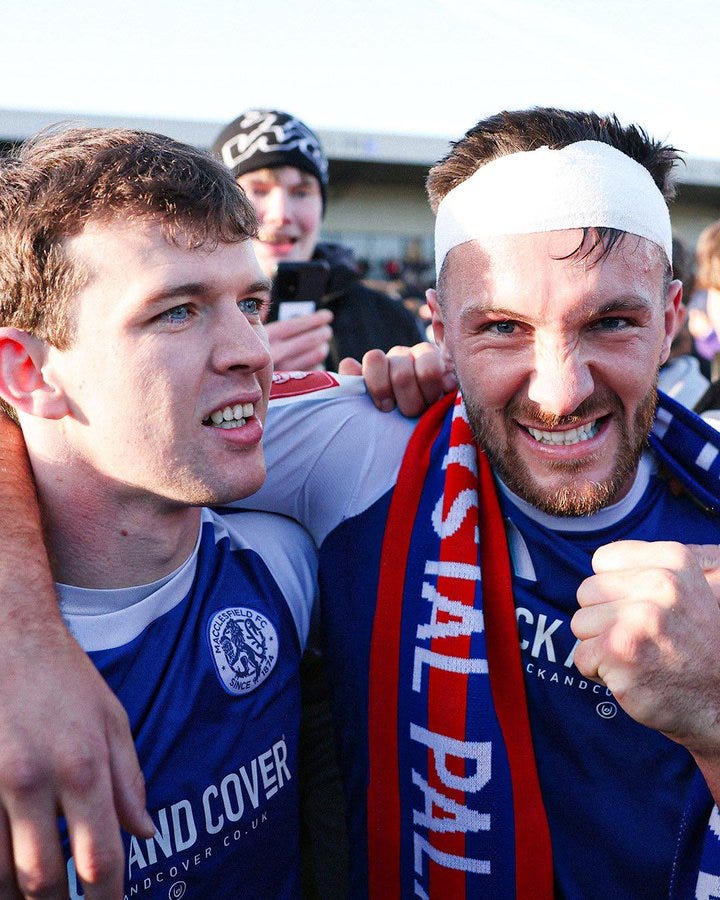
But more than representing a moment of ecstasy for Macclesfield supporters, I also hope that today has a much wider significance within football culture.
Even as an unapologetic football romantic, I am afflicted by an increasing inability to get “up for the cup”. In contrast to my youth – when FA Cup third round weekend was my favourite in the footballing calendar – the cup’s increasing predictability, the scrapping of replays and constant meddling from the footballing authorities has hugely detracted from my enjoyment of the competition.
Against this context, yesterday’s remarkable occasion was the ideal tonic, a pertinent and timely reminder that the so-called magic of the cup is so much more than a myth.
Let’s just spend a moment running through some of the iconic, timeless images from the game yesterday.
We had the battle-hardened Macclesfield captain Paul Dawson wiping blood from his brow and adjusting his cartoonish head bandage before crashing a header into the far corner to open the scoring.
We had the joyous image of Palace chairman Steve Parish sat as though sucking on a lemon surrounded on all sides by disbelieving Town fans, a stark contrast to the increasingly excitable Macclesfield chairman Rob Smethurst.
We had the quivering nervousness of Macclesfield supporters on the terraces hiding behind their tin foil FA Cups with fear after Palace pulled one back in stoppage time.
And then – best of all – the release at the final whistle, an unprecedented outpouring of celebration which saw thousands of Silkmen supporters pour onto the pitch like joy-fuelled zombies.
What this carousel of images shows us is that for all of its flaws and foibles, for all the ways the footballing authorities keep trying to warp and distort its DNA, the FA Cup still has an utterly unique magic. That magic lies in one simple factor: continuity.
The joy of the scenes that unfolded over three hours in the low Macclesfield sun lies in that they are so timeless. As I sat huddled by the fire watching the scenes at Moss Rose unfold in glorious technicolour, I found myself giddy with joy adding yet another layer to the glorious tapestry of third round memories I have experienced.
All of a sudden, I was once again 13, sat by the fire as Jermaine Beckford snaffles a winner for Leeds at Old Trafford. All of a sudden, I was once again 7, sat by the fire as Nigel Jemson glances home a last gasp past a gawping Nigel Martyn at Gay Meadow. All of a sudden, I was once again 5, sat by the fire watching a full match replay of Ronnie Radford’s glorious winner for Hereford against Newcastle at Edgar Street.
I suppose the point I’m trying to make is simple.
The reason that the FA Cup’s reputation as the “greatest cup competition in the world” holds any water lies in its continuity. Even as the game has undergone huge changes over the last century, the cup has continued to provide a steady stream of magical, unifying and transcendent moments of footballing folklore.
It was for this reason that yesterday’s match felt hugely symbolic. This was not only a victory for a more community-oriented model of football. It was a timely reminder that the FA Cup remains one of our most profound and consistent sources of that most nourishing element of the footballing diet: narrative.
At a moment when elite level professional football seems more distant than ever from the game’s communitarian roots, and the cup competitions are coming under more fire than ever, we would do well to keep the joyous scenes at Moss Lane at the front of our minds.
Yesterday was a potent reminder of why English football needs the FA Cup. Perhaps now we can treat it with a little more reverence.
Great breakdown! Talk about persevering! The magic of the cup is still alive! I wish here in the US the federation would embrace the US Open Cup the same way. All of the MLS teams don't even participate in it, which lessens its significance.
Great piece, though it also stirs memories of one of Albion’s worst days, the loss at home to Woking!
It was a great match yesterday, and important to savour, but it was almost certainly the only moment where the magic will be in evidence. Most games are televised behind a paywall, attendances in the early rounds will mostly be down, as clubs from the top two divisions field weakened sides so they can concentrate on the grind and slog of their league campaigns.
You off to Swansea today?
Me neither.